
William B. Kristan, Jr.
Professor and Chair
Section of Neurobiology, UCSD

e-mail: wkristan@ucsd.edu
Lab Homepage: Kristan Lab

      My colleagues and I are trying to determine how networks of nerve cells produce different behaviors, and how these neuronal networks are established during embryogenesis. We use physiological, anatomical, computational, and embryological techniques to characterize these circuits in the relatively tractable nervous system of the medicinal leech, and construct computerized models of them. One behavior, local bending, is produced by a distributed network similar to those used by more complex nervous systems, such as those of insects and monkeys, to produce directed movements. We use information theory to measure how this neuronal circuit encodes and passes its information from one layer to the next: from sensory neurons to interneurons, to motor neurons, and finally to movements. These studies will help to make "information processing" more than
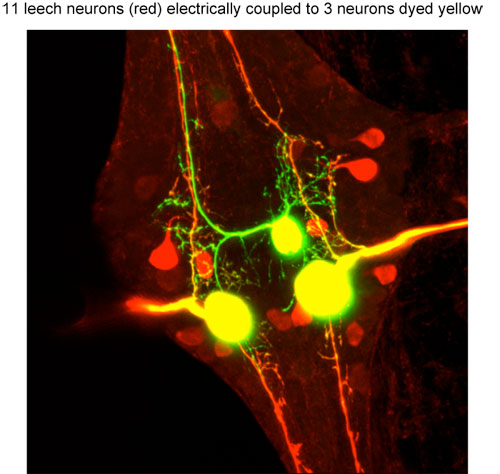
just a vague metaphor for how nervous systems function. Two others, swimming and crawling, use networks of neurons dedicated to particular aspects of these locomotor behaviors. Crawling appears to use a very different kind of central pattern generator than does swimming, and is much more responsive to sensory inputs. Computerized simulations of these behaviors are essential tools for understanding how these neuronal networks perform. A fourth behavior, whole-body shortening, appears to use both distributed and dedicated networks to produce a coordinated response to touch. We are now investigating how interneurons used in this behavior are also used in multiple behaviors, and how an animal decides to shorten rather than to swim. We have begun to use voltage-sensitive and calcium sensitive dyes for identifying neurons involved in different behaviors, for monitoring the activity of many interneurons at once, and for determining the locations of inputs and outputs of a neuron during the different behaviors. As a way to put the neuronal activity together with the behaviors, we are developing a biomechanical model of the leech's body based on the geometrical arrangement of different types of muscles, the motor neuronal activity patterns, and the contractile properties of the muscles. 

     We also study the mechanisms by which these neuronal networks are established during embryogenesis. We are testing several mechanisms that have been proposed for how the neuronal connections form, including attraction to common pathways and targets; competition for those targets; retrograde messages from the targets; and the role of synaptic activity in specifying the connections. One of the strengths of using the leech nervous system is that we can identify the neurons individually before and during the time that they make their first connections. Ultimately, we will approach these issues at the molecular level, to determine which genes are involved in helping to make the neuronal connections, as well as when and how they exert their effects. These studies will also help us to understand why particular kinds of neuronal connections are used to perform different
behavioral acts. 


     Briggman, K.L., Abarbanel, H.D.I., & Kristan, W.B., Jr. (2005). Optical imaging of neuronal populations during decision-making. Science 307: 896-901.

     Marin-Burgin, A., Eisenhart, J.F., Baca, S.M., Kristan, W.B. Jr., & French, K.A. (2005). Sequential development of electrical and chemical synaptic connections generates a specific behavioral circuit in the leech. J. Neurosci 25:2478-89.

     Kristan, W.B., Jr., Calabrese, R.L., and Friesen, W.O., (2005). Neuronal basis of leech behaviors. Prog. Neurobiol. 76:279-327.

     Briggman, K.L., Abarbanel, H.D.I., Kristan, W.B., Jr. (2006). From crawling to cognition: analyzing the dynamical interactions among populations of neurons. Curr Opin Neurobiol 16:135-44.

     Thomson E.E., Kristan W.B. (2006). Encoding and decoding touch location in the leech CNS. J Neurosci 26:8009-16.

     Briggman, K.L., Kristan, W.B., Jr. (2006). Imaging dedicated and multifunctional neural circuits generating distinct behaviors. J Neurosci, 26:10925-33.

     Kristan WB, Katz P. (2006). Form and function in systems neuroscience. Curr Biol 10:R828-31.
 

 Bill Kristan received his Ph.D. from the University of Pennsylvania. He was a postdoctoral fellow at Stanford University and an assistant research biologist at UC Berkeley. He held a Guggenheim Fellowship and was a Fellow of the University of Bielefeld, Germany.